
By Melissa Lanyon
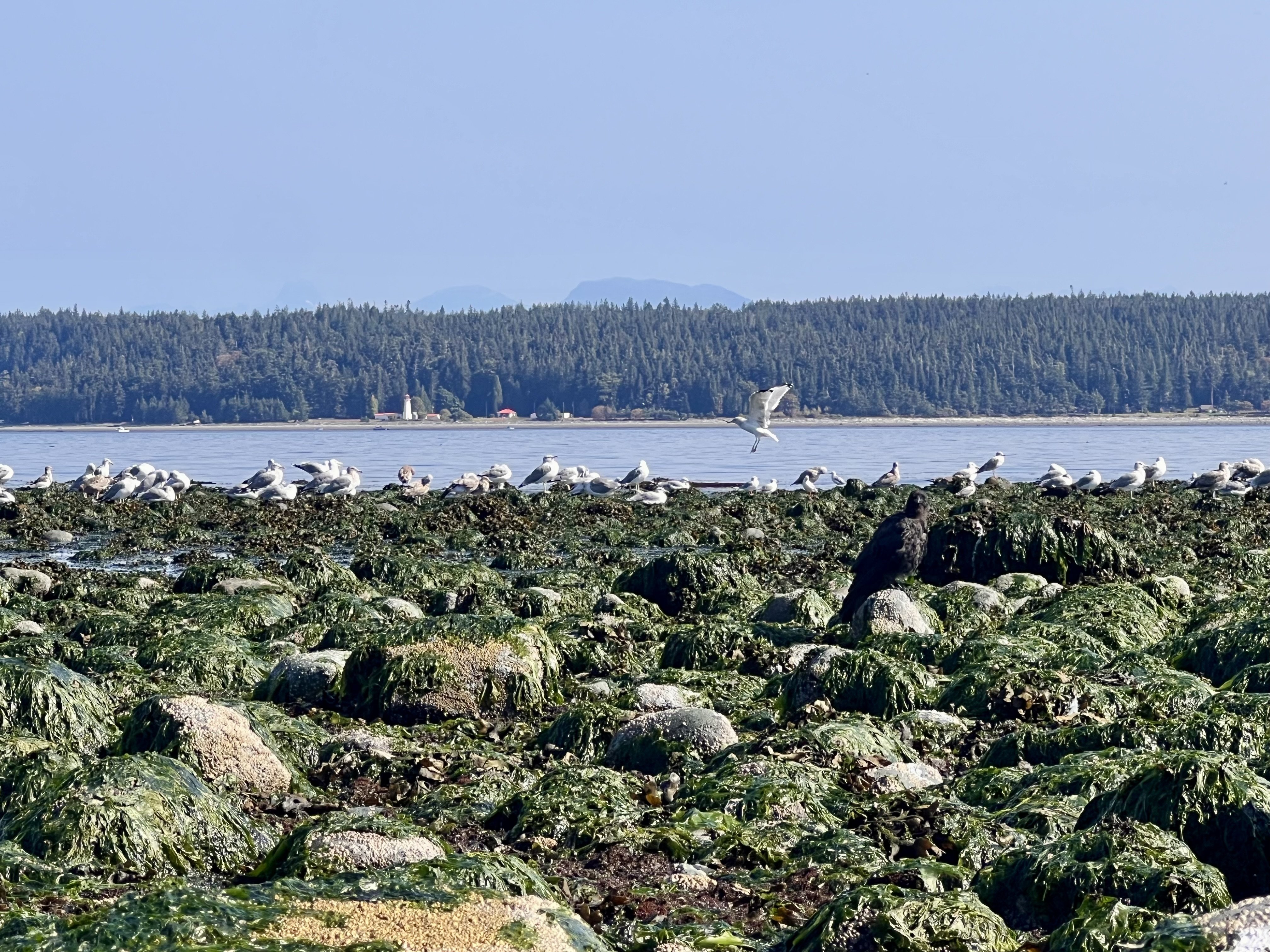
Featured image: Seagulls at Adams Park at low tide in Willow Point on August 25. Photo by Melissa Lanyon
As late-summer warmth lingers over Willow Point, a familiar controversy returns to the shoreline: what IS that smell?
For months, locals have complained about a sulfurous stench drifting through the neighbourhood that prompts continuing debates over whether the culprit is Mother Nature, or the municipal sewer system.
On community social media forums, there are a wide range of theories. Some residents suspect recent residential growth along the south end has overwhelmed the sewer mains, leaving unmoved waste baking in underground pipes. Others point directly to Lift Station #7 at 1551 Island Highway South.
Some long-time locals comment that the beach has always smelled this way in the summer, while many counter that the intensity has surged significantly over the last two summers.

What the public record shows
A review of municipal records shows that while public concern increased last summer, the topic has not required formal intervention from council. Across meeting agendas and staff reports from 2024 through mid-August 2026, the Willow Point odour appears in the city’s public record only once, as a Council Information Bulletin (#25-23) dated September 4, 2025.
In that bulletin, staff noted that after a half-dozen complaints about the smell near Willow Point Harbour, Liquid Waste Services crews repeatedly inspected area lift stations and confirmed all systems were operating normally. During the investigation, staff identified a large band of rotting seaweed stretching from Adams Park to Lift Station #7 near Simms Creek, noting that when exposed to direct sun on hot days, the vegetation “rots quickly and can smell like raw sewage.”
Given the issue was determined to be environmental rather than a mechanical failure, it was handled as an operational matter, with front desk reception and dispatch briefed to answer incoming public inquiries.
Diagnostics and 24/7 monitoring
According to city Communications Manager Alison Harrower, that assessment remains unchanged, backed by continuous diagnostic oversight.
“Through these investigations, the wastewater system has been found to be operating properly, and there has been no indication that the odour is originating from city infrastructure,” Harrower stated, citing naturally occurring seaweed, warm weather, and tidal cycles as “the most likely source of the odour.”
To ensure local infrastructure is not at fault, the city relies on 24/7 real-time monitoring of lift stations and other data-gathering nodes in its system. The city measures wastewater levels and flow, pump run status, discharge pressure on the sanitary line, and hydrogen sulfide levels. Physical infrastructure in Willow Point, including Lift Station #7, is also equipped with specialized carbon filters and undergoes routine inspections and maintenance in person and by camera to rule out blockages or venting failures.

So, why the B.O. (beach odour)?
According to coastal health and marine science research, the culprit behind the late-summer stench at numerous BC beaches is increased levels of hydrogen sulfide, the exact same chemical compound produced in sewer systems.
Research shows that this compound can build up in sewer systems and cause corrosion over time, reducing the expected life of concrete pipes, especially in systems where waste has to travel a long way and spend extended time in the system. In the past, it’s created expensive problems for municipalities around the world, and a great deal of research has been done to mitigate the issue through better detection and systems design.
However, it can also build up naturally along the shoreline during hot weather and low tides.
The smell is connected to oxygen and how organic matter breaks down. When plant matter, including seaweed, decomposes in open, well-aerated conditions, oxygen-breathing bacteria process the material cleanly, releasing harmless and odourless byproducts. However, when thick mounds of wet seaweed pile up along the shoreline, the inner layers are cut off from circulating air.
The process can be compared to a tightly sealed compost bin left out in the direct August sun: once the trapped bacteria consume whatever trace oxygen remains, oxygen-deprived (anaerobic) microbes take over. Because these anaerobic bacteria cannot breathe oxygen, they feed on the sulfur-rich compounds naturally found in marine plants, releasing pungent hydrogen sulfide gas as their metabolic waste. This smelly gas is heavier than air so it tends to settle and linger.
No risk to human health
While the smell can be overpowering, it does not indicate a toxic hazard. According to health profiles from the Canadian Centre for Occupational Health and Safety (CCOHS), the human olfactory system can detect hydrogen sulfide at concentrations as low as 0.001 parts per million, meaning the brain registers a pungent stench long before atmospheric levels come anywhere near a threshold that could prompt health concerns.
While all the evidence seems to indicate the smell is from a natural shoreline process, the city says staff continue to investigate specific reports. Residents who notice sudden or localized spikes in odour are encouraged to log the exact date, time, and precise location when reporting concerns to Dogwood Operations. The department can be reached at 250-286-4033.




Leave a Reply