
By Grant Warkentin
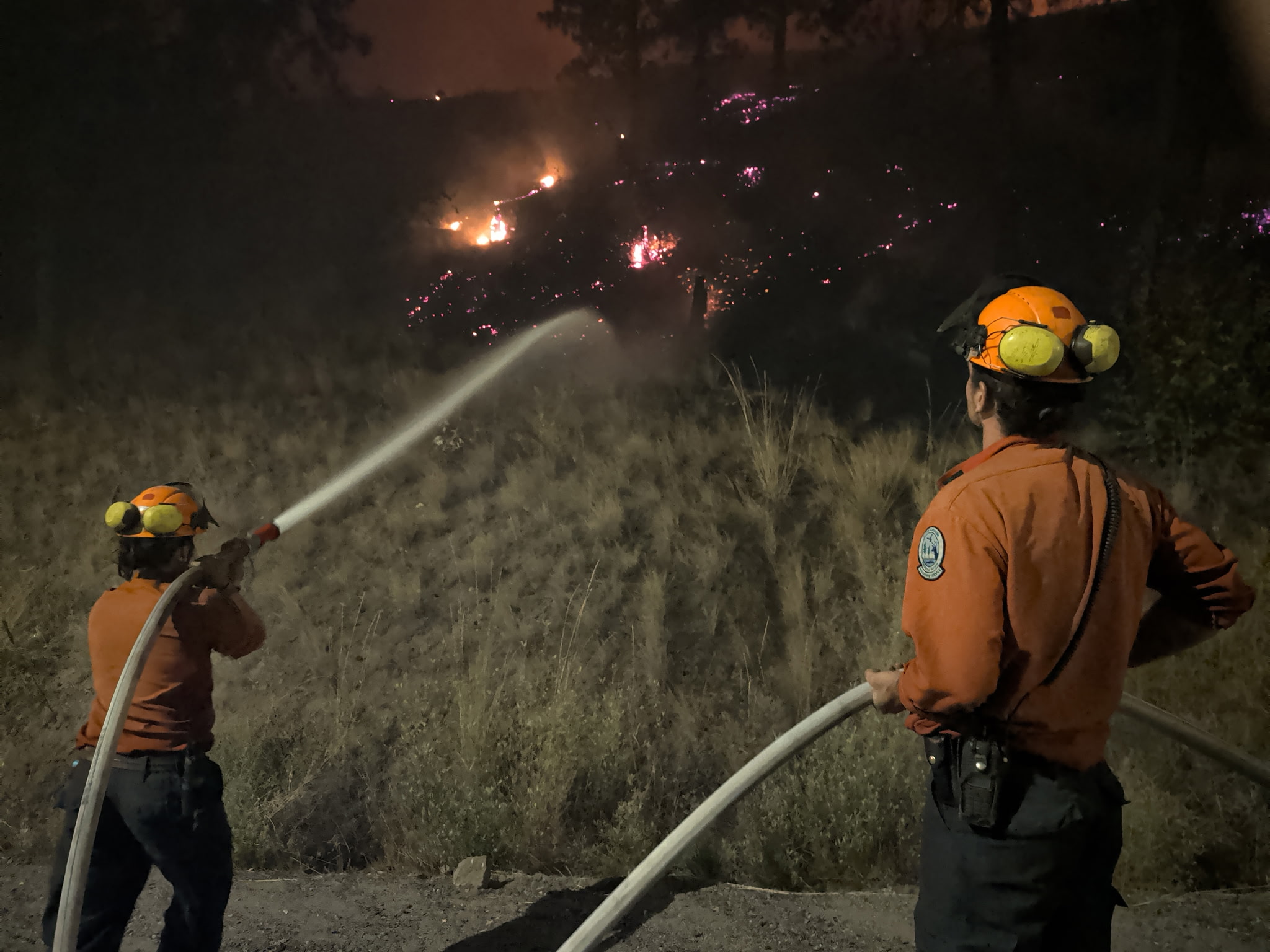
Featured image: Firefighters work through the night to suppress fires near Penticton on August 7, 2026. Photo from BC Wildfire Service
While BC burns, misinformation continues to spread, just like the wildfires threatening communities from Williams Lake south to Osoyoos.
You can thank the federal government, and their NDP enablers, for making it so “rural BC communities lost access to credible journalism at the precise moment they needed it most, with direct and documented consequences for community trust, emergency compliance, and public safety.”
Those are the direct words of two UBC Okanagan researchers, who travelled to Ottawa this spring to present evidence showing legislation originally intended to extort money from social media giant Meta has now caused real-world harm in BC, thanks to restrictions preventing Canadians from sharing news links on Meta platforms.
Since spring, their warning has been proven right again as dangerous conspiracy-peddlers and malicious clout-chasers dominate online discussions about this summer’s wildfires. Every piece of bad advice, false information, and outright life-threatening lies currently circulating on Facebook and Instagram while residents scramble to save their homes should be laid directly at the feet of the federal Liberal government, and all the NDP MPs who voted in favour of the Online News Act in 2023.
That includes former NDP MP for South Okanagan—West Kootenay Richard J. “Dick” Cannings, whose former riding is now on fire. He chose not to run for re-election in 2025, but the consequences of his and his party’s poor judgment in 2023 are harming British Columbians today. It would be interesting to ask him now if he regrets supporting this act, which has forced his former constituents to suffer lies and misinformation online while also fighting the real fires threatening their homes.
Warning from 2023 wildfires goes unheeded by feds
The federal government had ample warning and credible evidence proving the act was dangerous before this summer’s fires, but consistently ignored calls for it to be repealed.
This spring, Blair Visscher and Dr. Greg Garrard, researchers from UBC Okanagan, travelled to Ottawa to urge the federal government to scrap the Online News Act. They presented their findings to the federal Standing Committee on Canadian Heritage.
Their report, titled “When Good Intentions Cause Harm: The Online News Act, Meta’s News Ban, and Public Safety During Wildfire Emergencies,” shows that after Meta banned all news links for Canadian users on its platforms in reaction to the act, conspiracy theories and lies quickly filled the vacuum.
Meta is a shareholder-focused megacorporation and acts like one, for better or for worse. When confronted with the Canadian government’s demands via the act to pay up, “or else,” it chose “or else” and left Canadians to pay the consequences.
Since August 2, 2023, six weeks after the act came into effect, Canadian users have been prohibited from sharing links to news articles. Meta made the decision to block links rather than participate in the Act’s hare-brained compensation scheme, which would have required the company to monitor Canadian user activity and, based on click-throughs to news websites, pay money into a slush fund allegedly intended to help small news outlets across Canada.
Within ten days after the ban took effect, the Act’s failure was already apparent, with conspiracy theories and misinformation on Facebook directly responsible for a public confrontation with RCMP at a highway blockade during wildfires in the Shuswap region in 2023.
“Crucially, this escalation was driven not by the severity of the fire itself but by the interaction of three factors: eroded institutional trust in rural Canadian populations; algorithmic amplification of emotionally charged content; and the removal of credible journalism from the platform by the news ban,” says the report by Visscher and Garrard.
No such issues before ill-advised act passed
The report is buttressed with pre-act baseline information. It looked at three wildfires in 2016, 2021, and 2023, comparing the public reaction and how information spread during the crisis events. It found that during the 2023 Shuswap fires, “conspiracy-related narrative content” made up nearly 17 per cent of discourse on Facebook about the situation, compared to zero during the 2016 fires in Fort McMurray.
Let me repeat that.
We went from zero cases of “conspiracy-related narrative content” during the Fort McMurray fires, the costliest natural disaster in Canadian history, to nearly one in every five posts about the Shuswap fires being complete bupkis.
I wonder how bad it is now; I would bet it’s a lot higher than one in five posts this year.
Kill the bill
The Act can’t be saved, the researchers say, arguing that it’s a waste of time to try and force Meta and other social media platforms to abide by the last century’s pre-Internet models for financially fostering “Canadian content.”
“Full repeal of the Online News Act, followed by replacement with mechanisms that do not depend on platform cooperation, is the only viable path forward,” the researchers say. “If Meta will remove news content rather than accept any obligation to compensate publishers, the policy framework should not be built around platform behaviour at all.”
Act never helped local journalism in the first place
As one of the Canadians working in local news media this act was allegedly supposed to help, I wholeheartedly agree with the researchers. This act should have never been passed, it’s garbage and has been nothing but a disaster.
The Online News Act is the equivalent of trying to force the owner of the bulletin board at the community grocery store to take note of how many people pull off the little phone number tabs on posted ads, put money into a tin on a per-tab basis, and then hand the tin over to a government-appointed redistributor who may or may not make sure the people posting on the board get that money.
As we have seen with how the federal government handled Google’s response to the Act, community reporters are at the absolute bottom of the priority list for who gets a cut.
Unlike Meta, Google agreed to contribute $100 million annually to a fund which is overseen by the “Canadian Journalism Collective,” a group hand-picked by government to redistribute the money. And of course, the usual suspects all got their beaks wet before any community reporter saw a dime.
The first public accounting of the fund’s distribution only came out last fall, and as expected, more than half of the $100 million went to ten of Canada’s largest media corporations, including CBC, Bell, Rogers, PostMedia, Corus, Canadian Press, and TVA. The act has done nothing but buy a few more years for failing legacy media corporations, which continue to close newsrooms and radio stations across the country despite this money in their pockets.
As for CBC, its $7 million share of the money is not nearly enough to cover the $38 million in record-breaking salary increases employees received last year.
Who benefits from the Online News Act? Nobody but the big boys, and the state’s broadcaster.
It’s time for the federal government to take the L on this one and repeal the act, before it makes the spread of dangerous misinformation even worse.
And if we truly care about supporting local journalism, the researchers have presented the government with a list of practical options to consider that don’t require trying to strongarm the largest corporations in the world with ridiculous requirements.
Hopefully once BC makes it through this terrible fire season, our lawmakers can revisit the issue with some common sense that helps rather than hinders community journalism, and helps get a handle on the nonsense spreading across social media like destructive wildfires.




Leave a Reply