
By Grant Warkentin
Mowi is getting out of the salmon farming business on Canada’s East Coast, and there could be future implications for the BC industry.
On June 30, the Norway-based Mowi ASA signed a deal to sell its entire Canadian east coast operation, which harvested 17,200 tonnes of farmed salmon in 2025, to competitor Cooke Aquaculture. In a statement filed with the Oslo stock exchange, Mowi says it made the deal “in order to further improve Mowi’s farming portfolio and focus even more on core farming geographies.”
Last year was rough for Mowi’s farms in Atlantic Canada. A September 2025 die-off killed more than 600,000 salmon at three Newfoundland sites, and prompted the province to suspend 10 of the operation’s 47 licences. The event helped push Mowi’s Canadian operations to a roughly $78 million (CAD) operational loss over two quarters. The company’s 2025 annual report says the farms struggled with a “warm summer and autumn creating unfavourable environmental conditions including low oxygen levels.”
Mowi takes a write-down, follows Grieg’s exit
The share purchase agreement with Cooke will sell Mowi Canada East to Cooke for $225 million, $90 million less than what the company paid to acquire the holdings of Northern Harvest Sea Farms in 2017-2018. Mowi will also take a write-down of $140 million. The deal will be finalized later this year.
Glenn Cooke, CEO of Cooke Aquaculture, said in a news release that all of Mowi Canada East’s 250 employees will continue their employment under new management.
“This is an exciting growth opportunity for our Atlantic Canada operations,” he said. “We look forward to welcoming Mowi Canada East’s 250 employees to Cooke, and to working together to grow the sector and sustainably farm Atlantic salmon for customers in this region and beyond.”
The move leaves Cooke as the largest commercial salmon farmer on the East Coast. Cermaq purchased Grieg Seafood’s Placentia Bay cluster of farms and hatchery last year when it acquired all of Grieg’s Canadian assets, and remains as Cooke’s only significant competitor in Atlantic Canada.
The Grieg purchase is still having effects on operations and employees in BC. Cermaq continues merging the local management structures of both companies into one, and has parted ways with some of its longest-serving Campbell River-based managers in charge of salt water and freshwater production in favour of retaining managers from Grieg.
Mowi Canada West has been under “strategic review” since 2024; the company has not yet formally announced a conclusion. Mowi’s annual report for 2025 describes its West Coast operations as having “highly uncertain future prospects.”
All BC salmon farms face a federal government-mandated deadline of June 30, 2029 to either transition to fully closed containment systems or stop farming altogether, when their licences are set to expire.
A short-lived scramble for the East Coast
The Cohen Commission’s final report in 2012 left BC salmon farmers with a deadline: prove farms in the Discovery Islands posed “minimal risk of serious harm” to wild salmon, or shut them down after September 30, 2020.
Facing the possibility of losing farm sites in BC, the three main companies began attempts to expand into the East Coast salmon farming industry. In 2014, Grieg made the first move with a proposal to set up a cluster of farms and a land-based hatchery in Placentia Bay, NL. The company started farming after clearing the provincial environmental assessment process in July 2016.
Later that year in December, Marine Harvest (now Mowi) purchased the assets of the bankrupt Gray Aqua Group. One year later, they purchased Northern Harvest Sea Farms in a deal that was allowed to go ahead by the Competition Bureau in July, 2018.
In 2019, the Trudeau Liberals formalized their intentions to phase out all conventional net pen farms in BC by 2025. That same year, Cermaq launched its “Hello Nova Scotia” campaign in an attempt to win the hearts and minds of the East Coast and establish its own cluster of farms in Atlantic Canada. The campaign was abandoned after one year.
What remains?
Since the original Cohen Commission 2020 deadline has come and gone, most salmon farms on the East Coast of Vancouver Island have been removed. All farms in the Discovery Islands have been shut down. Mowi remains the only farmer operating on the north end of Vancouver Island, managing farms near Port Hardy and Quatsino, and also farther north up the coast near Klemtu.
Cermaq maintains a cluster of farms and hatcheries on the West Coast near Tofino, and now manages the former Grieg farms in Nootka Sound.
Creative Salmon farms chinook salmon at several sites on the West Coast, also near Tofino.
Since 2010, BC’s total farmed salmon production has declined by one quarter, from nearly 71,000 tonnes (live weight) that year to around 54,000 tonnes in 2024.
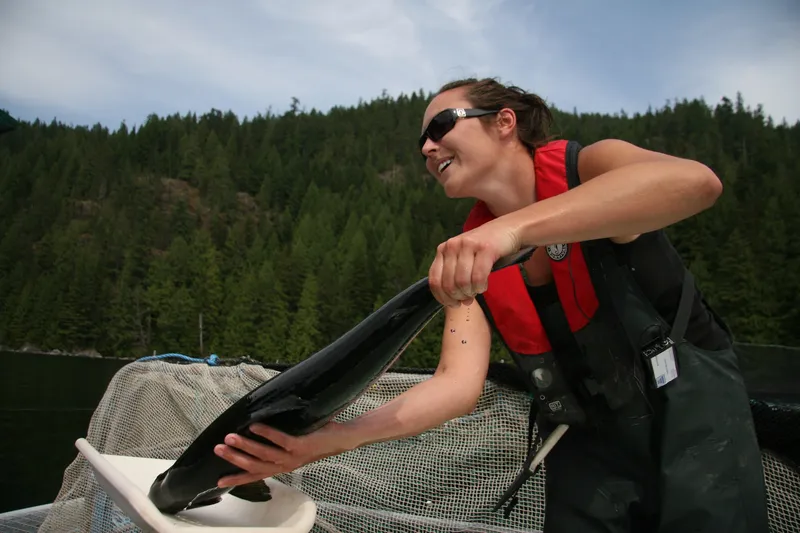
Featured image: Worker with a farmed salmon at the now-closed Marine Harvest / Mowi Sonora Point farm near Campbell River. Photo by Grant Warkentin



Leave a Reply