
By Grant Warkentin
A helicopter caused its own lightning strike in a harrowing 2023 incident over North Pender Island.
That’s the conclusion of the Transportation Safety Board of Canada (TSB), which released its investigation report today into the October 24, 2023 incident.
Shortly after 9 am that morning, a Helijet commercial flight with 12 passengers and two crew left Vancouver for Victoria. They encountered turbulence and heavy rain over North Pender Island and only 18 minutes after take-off there was a loud bang and a bright white flash, and critical electronic systems failed.
The captain managed to take control of the aircraft but it dropped like a stone, descending from 4,000 feet above sea level to 881 feet in only 36 seconds, falling at a speed of nearly 96 kilometres per hour.
Once it dropped out of the cloud cover, the captain was able to visually orient the aircraft and get it back under control. With no damage yet apparent, the captain flew the helicopter to Victoria, choosing to continue to their destination instead of heading back through the storm.
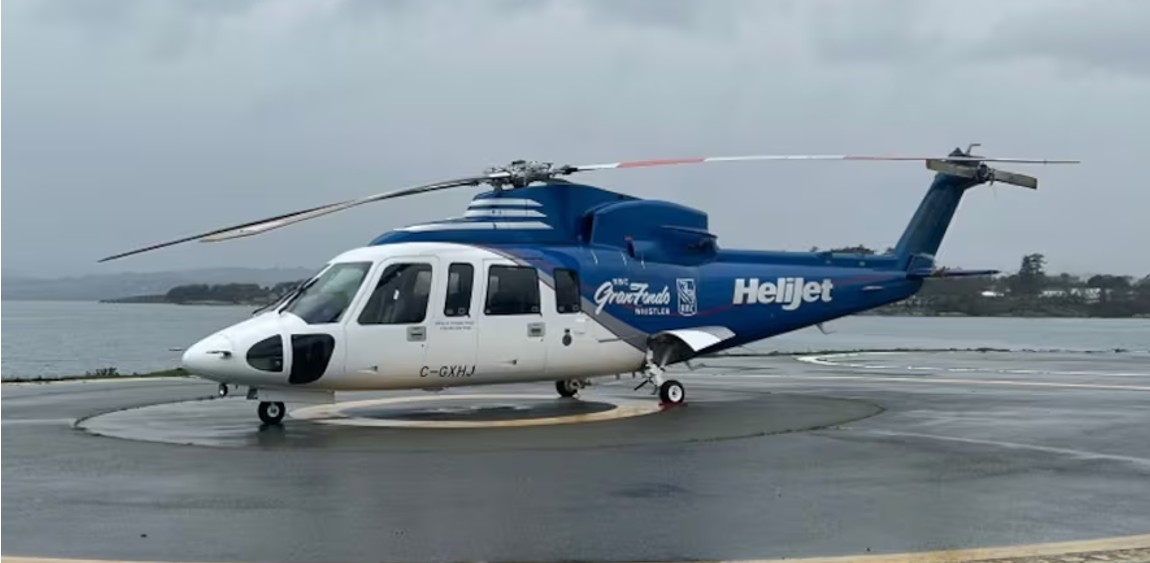
After landing, the crew discovered the lightning strike had blasted one of the tail rotors clean off the Sikorsky helicopter.
The TSB investigation shows the crew did everything by the book, and that no one could have predicted or avoided the lightning strike.
Helicopter-induced lightning
Investigators concluded that a rare phenomenon called “helicopter-induced lightning” caused the strike.
“Helicopter-induced lightning is a phenomenon in which the helicopter triggers a lightning strike; it often occurs in areas where there is little natural lightning activity,” says the report. “Helicopters, like all aircraft, acquire a negative charge that is created by the frictional contact with the air during flight. The rapidly rotating main rotor and tail rotor blades will generate the greatest concentration of negative charge and are likely an entry point for the initial lightning stroke.”
Usually the negative charge dissipates when the aircraft lands. But under certain weather conditions, it can actually attract a lightning bolt.
“When the helicopter encounters a positively charged region of a cloud and the potential difference is great enough between the opposing charges, the helicopter can trigger a positive lightning strike,” says the report.
The phenomenon has been documented in Europe’s North Sea region, but this appears to be the first time it’s been connected to an aviation incident in the Pacific Northwest.
Featured image: Helijet’s helicopter after landing in Victoria. Image from Transportation Safety Board of Canada




Leave a Reply