
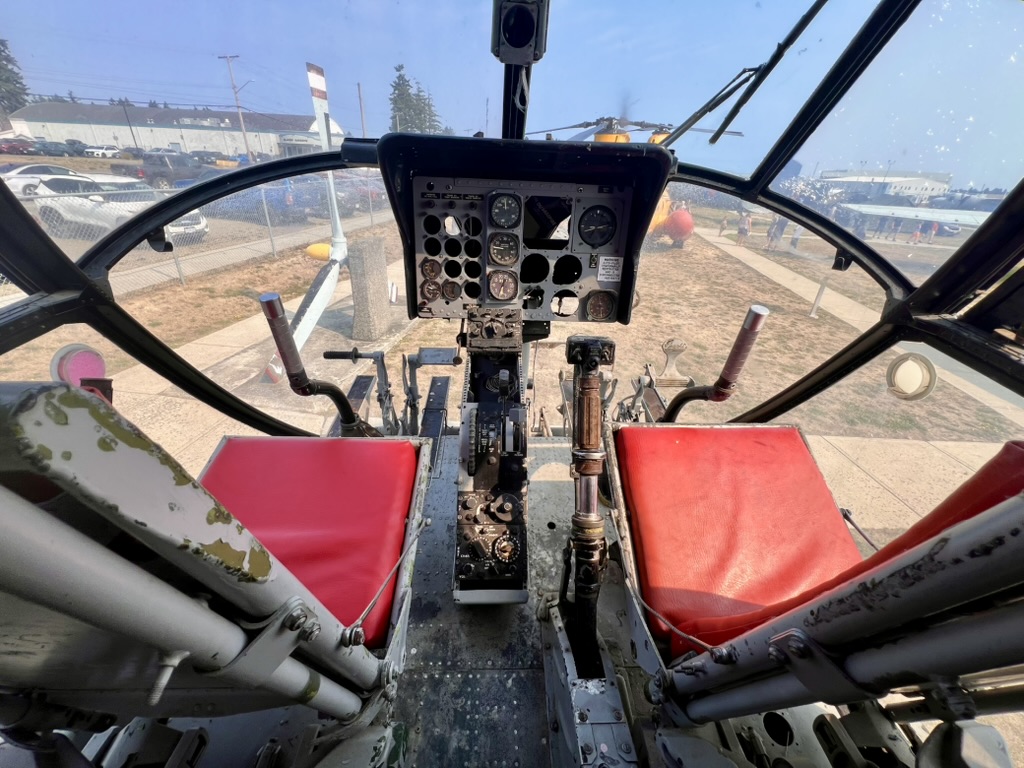
Featured image: Inside the cockpit of a Piasecki H-21 “Workhorse” helicopter at the Comox Air Force Museum’s Open Cockpit Day on August 15, 2026. Photo by Melissa Lanyon
By Melissa Lanyon
COMOX, B.C. — For aircraft enthusiasts and curious families, Saturday in Comox offered a hands-on chance to experience a variety of cockpits and cabins showcasing Canadian military aviation history.
The Comox Air Force Museum hosted its annual Open Cockpit Day at the 19 Wing Heritage Air Park on Aug. 15, unsealing the hatches of historic Royal Canadian Air Force (RCAF) aircraft and inviting the public to step inside living history.
“Open Cockpit Day is where we open up a few of our vintage aircraft so the public can walk around inside, maybe sit in the cockpit, take some selfies, and post on social media,” said Comox Air Force Museum Director Lt. Ryan Lees. “We really do appreciate our local community here in the Comox Valley… It’s a good way to foster local connections.”
The park was buzzing with visitors exploring aircraft on display, including the bright yellow CC-115 Buffalo and the tandem-rotor Piasecki H-21 “Workhorse” helicopter.
For young visitors like brothers Brazeau and Biørn, stepping into the controls of the vintage Piasecki was an unforgettable experience.
“So cool!” the brothers agreed after exiting the aircraft.
They were particularly fascinated by how the controls worked, noticing with surprise how the control sticks on both sides moved together in tandem when only one was shifted. With an uncle who flies, both admitted that sitting in the pilot’s seat made them consider a future in the cockpit themselves.


Living Memory on the Tarmac
Behind every aircraft was a wealth of operational memories, shared by dedicated volunteers stationed across the grounds.
Mel Birnie, who has volunteered with the museum’s collections and archives department for 22 years, stood on the tarmac sharing his knowledge with visitors. Birnie served in the air force from 1963 to 1990, following in the footsteps of his father, who was also an air force member. Between his childhood in a military family and his own 27-year service, Birnie lived in 55 different homes across the country.
Reflecting on his decades in uniform, Birnie noted that while a military career meant hard work and frequent relocation, “it felt pretty good to represent your country.”

The Vampire Lands in its New Home
A major focal point of the day was the Heritage Air Park’s newest addition: the Vampire Pavilion.
The de Havilland Vampire marked an important turning point in aviation history, serving as a transitional stepping stone between traditional 1930s propeller aircraft and the modern jet age. Originally conceived in 1942 as a top-secret British Second World War program code-named “Spider Crab,” the aircraft was redesigned to fly at high altitudes and high speeds to intercept potential German jet bombers. The prototype was eventually renamed the Vampire to give it a more menacing moniker.
The aircraft quickly built an impressive resume: it became the first pure jet-powered aircraft to land on and take off from an aircraft carrier, served as Canada’s first operational fighter jet, and set a world altitude record of 59,500 feet in March 1948.
The Comox museum’s particular 1948 de Havilland Vampire Mark III (tail number 17031) was flown into 19 Wing Comox in 2000, but had to remain tucked away in storage on base for more than two decades. Unlike the park’s other aircraft on display outdoors, the Vampire now sits inside a dedicated, climate-controlled glass pavilion.
Lt. Lees noted that because the aircraft’s cockpit pod was built with composite wood containing Canadian Sitka spruce, it requires indoor climate control to prevent deterioration. The $1.7-million pavilion project was funded through extensive community donations, specialized in-kind trades, and volunteer contributions.

Preserving Coastal Aviation History
The museum’s roots reflect the broader history of military aviation on the coast. Originally constructed in 1942 as a Second World War training base, 19 Wing Comox closed in 1946 before reopening in 1952 in response to the Korean War and Cold War tensions. Today, the museum continues its mission to preserve and share West Coast military aviation history.
The Comox Air Force Museum is open to the public year-round, Tuesday through Sunday from 10 a.m. to 4 p.m. (closed Mondays). Upcoming community events at the Heritage Air Park include Boo at the Air Park for Halloween, as well as the annual holiday light display throughout December.




Leave a Reply