
By Evaye Lanyon
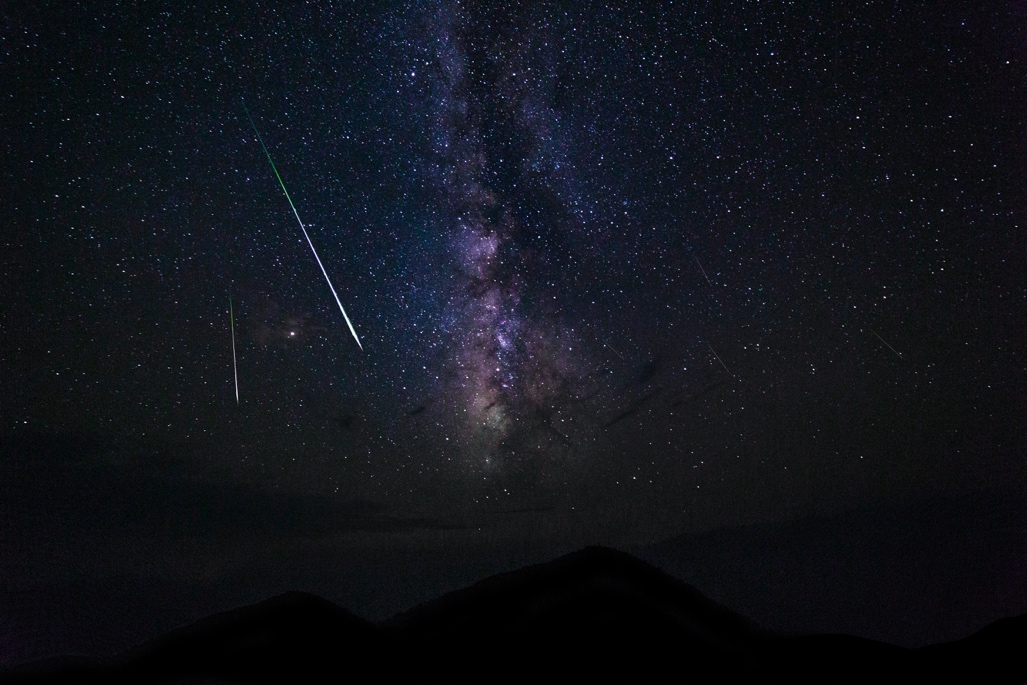
Featured Photo: “Perseid Meteor Shower,” by Austin Human / Unsplash
Strathcona stargazers are in for a bright show this week, when the annual Perseid meteor shower peaks overnight on August 12–13.
With a new moon leaving the sky especially dark, viewers away from city lights could spot dozens of shooting stars an hour. There can be up to 100 observable meteors an hour under ideal dark-sky conditions.
When and Where to Watch it
The best nights to watch the skies will be on Wednesday night and early Thursday morning, and again on Thursday night and early Friday morning. Although the meteor shower will be visible after nightfall, the best viewing will be after midnight until dawn.
To spot the meteors, stargazers should aim to look toward the northeast horizon, although meteors can streak across the entire sky. It’s best to find a dark, open area away from major city lights, and avoid looking at your phone to protect your night vision.
Host of celestial phenomenon
August 12 will be unusually eventful for skywatchers. There are actually several different celestial events happening on the same day: a planetary alignment, a partial solar eclipse, the new moon, and the Perseid meteor shower.
Before sunrise, six planets will appear spread along a broad arc of the sky in what is called a planetary alignment. Some will be difficult to spot: Uranus and Neptune require binoculars or a telescope, while Mercury and Jupiter sit low in the brightening sky.
Later that morning, a total solar eclipse will cross parts of Greenland, Iceland and Spain. In Campbell River, however, only about 0.2 to 0.37 percent of the Sun will be covered between 9:09 and 9:38 a.m., making the partial eclipse nearly unnoticeable to the naked eye.
That night, the main local event arrives as the Perseid meteor shower reaches its peak under dark, moonless skies. This year, the viewing conditions are expected to be exceptional because the peak coincides with a new moon, so moonlight won’t outshine the fainter meteors.

The Origin of the name “Perseid”
Their radiant, which is the point in the sky from which the Perseids seem to come from, is actually the constellation Perseus. This is also where the name for the meteor shower comes from.
Why the Perseids return each August
The Perseid meteor shower happens every August because Earth crosses the same exact path of dust and rock debris left behind by Comet Swift-Tuttle, named after the two people who discovered the comet in 1862: Lewis Swift and Horace Tuttle. As the comet travels around the Sun, it sheds material along its orbit. Earth crosses that debris trail at roughly the same point in its own orbit every year, which is why the shower appears so reliably in mid-August.
Why meteors can appear different colours
Meteors look like different colors because of the specific chemical elements inside the rocks from space, and the gases in Earth’s atmosphere. As the meteor enters the atmosphere, high heat melts and makes the materials glow. Here is a quick guide to the colour and meteor elements.
• Red: Created when the heat excites nitrogen and oxygen in Earth’s atmosphere.
• Yellow or Orange: Made by burning sodium or iron.
• Green or Blue: Made by vaporizing magnesium.
• Purple or Violet: Caused by glowing calcium.
A reason to look up
Whether you’re meeting up with friends, family, or just stepping into your backyard for a few minutes, the Perseids are definitely worth a watch. All you need is a safe, dark spot away from bright lights and some time for your eyes to adjust to the night sky.



Leave a Reply