
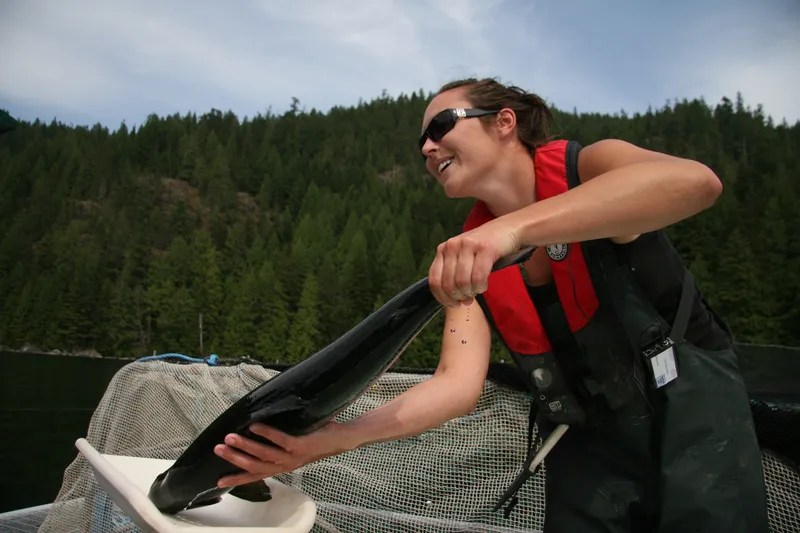
Despite local First Nations support, salmon farms will not be coming back to waters around Campbell River, the Federal Court of Appeal has ruled.
In a decision handed down on January 29, Chief Justice Yves de Montigny ruled the federal fisheries minister’s decision to not renew salmon farm licences in the Discovery Islands region was justified. The court dismissed an appeal filed in 2024 by the We Wai Kai First Nation, which was backed by the Wei Wai Kum First Nation, Mowi Canada West, Cermaq Canada, and Grieg Seafood, attempting to have the federal Fisheries and Oceans Canada (DFO) minister’s decision overturned.
In the latest judgment, de Montigny says Mowi and the applicants should have focused on the scientific uncertainty at the core of the issue, and rejected suggestions that the minister gave an unfair weight to scientific information supplied by activist groups and anti-salmon farming activists. He points out the companies were aware of the information provided, but chose to argue against the minister’s decision for different reasons.
“Mowi did not make science the central focus of its submissions and focused instead on social, cultural, and economic factors,” says de Montigny.
They should have expected the focus to be on science, he says.
“Mowi had every opportunity to share its views with the Minister on any issue that it cared about. If Mowi chose to focus its representations on the economic and social repercussions the termination of aquaculture in the Discovery Islands would have for its employees and its contractors, on its agreements with First Nations, and on other socio-cultural factors, it was of its own choosing and not because of its ignorance of the case it had to meet,” says de Montigny. “After all, the impact of salmon farms and the potential risks resulting from the transfer of pathogens and diseases to wild salmon had been identified by the Cohen Commission, and the Minister had clearly indicated that this would be a key driver in her management of the fisheries and on the implementation of the Prime Minister’s mandate to develop a transition plan to phase out the salmon aquaculture activities.”
As for the minister, de Montigny says she acted appropriately, weighing scientific and social factors to make a decision, while also following the precautionary principle as outlined in the Fisheries Act. He says she was also justified in disagreeing with the recommendations from her own ministry and the Canadian Science Advisory Secretariat, a group of scientists who advise government ministries.
“In light of the evidence that was before her and of her disagreement with the advice provided by DFO as to the risk or uncertainties in relation to the impact of aquaculture, I agree with the Federal Court that it was reasonably open to the Minister to determine that the Discovery Islands are a unique area and warrant greater protection,” he says.
The judgment marks the end of a court battle that’s been ongoing since 2020, the deadline year set by the Cohen Commission to prove salmon farms posed no more than a minimal risk to wild salmon. While scientists at DFO did publish a series of studies showing salmon farms in the region were little risk to wild salmon, the minister raised concerns that there was not enough research done on the cumulative effects of factors affecting wild salmon, including disease and climate change. Justice de Montigny says with salmon farms as one of the potential factors within the minister’s control, she was justified using the precautionary principle to eliminate farms as a potential negative impact on wild salmon in the region.
Ecojustice represented the environmental groups and activists involved in the case, including the Living Oceans Society, and published a press release celebrating the decision.
“We all owe a debt of gratitude to these ministers who stood firm in showing the Department what precautionary decision-making looks like,” said Karen Wristen, the society’s executive director, in the release. “Their decisions to close the farms have been followed by strengthening returns of pink, chum and sockeye salmon that migrate through the Discovery Islands.”
Despite Wristen’s claims, there is little evidence that removing farms had anything to do with improved salmon runs in the region during the last five years.
The BC Salmon Farmers Association has not yet issued any comment on the ruling.



 The Strathcona Standard
Leave a comment